

Why Is Grade 2 Stud Link Anchor Chain Still Popular Despite Higher-Grade Options
2026-08-20
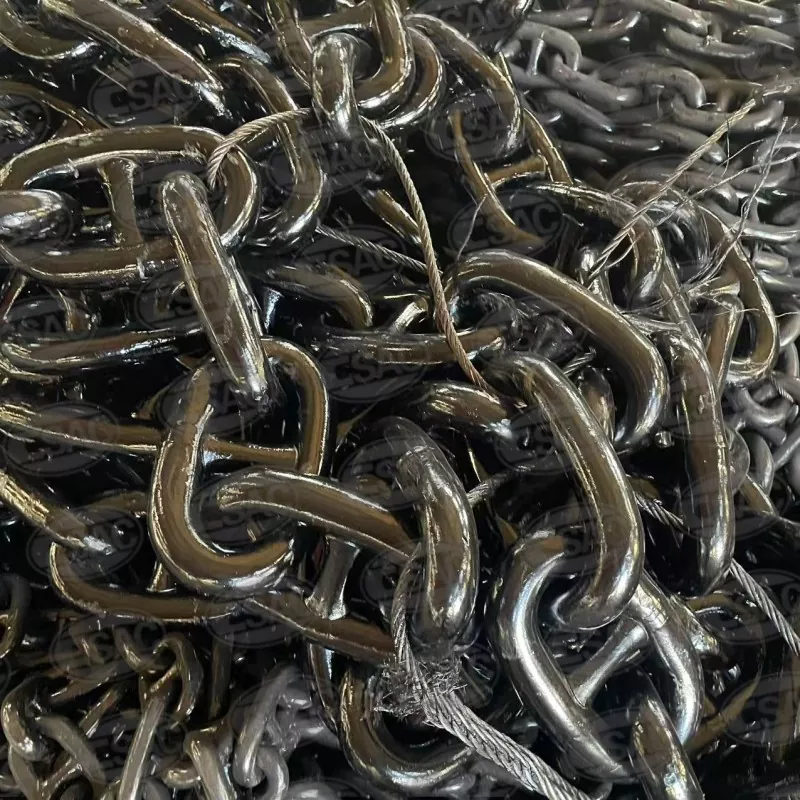
When selecting mooring or towing equipment for commercial vessels, offshore platforms, or heavy-lift barges, the anchor chain specification often becomes a focal point of debate. While Grade 3 and even Grade 4 chains offer higher tensile strength, Grade 2 Stud Link Anchor Chain remains a widely specified choice across shipyards, repair docks, and fleet operators. CSAC has supplied this grade continuously for over two decades, and the demand curve shows no sign of flattening. The explanation lies not in nostalgia, but in a balanced equation of cost, fatigue life, repairability, and classification society rules—factors that often outweigh pure strength on a operator’s spreadsheet.
The Core Engineering Trade‑Off
Higher grade does not automatically mean better suitability. The table below summarizes the critical performance indicators that influence procurement decisions:
| Parameter | Grade 2 Stud Link Anchor Chain | Grade 3 Chain |
|---|---|---|
| Minimum Breaking Load (MBL) | Baseline (100%) | ~15–20% higher |
| Fatigue Resistance (constant stress) | Excellent (ductile) | Moderate (more brittle) |
| Bend radius tolerance | More forgiving | Requires larger gypsy/sheave |
| Weld repair feasibility | Full re-certification possible | Often prohibited after damage |
| Corrosion allowance (loss over 10 yrs) | 2.0–2.5 mm | 1.5–2.0 mm |
| Cost per tonne (ex-works) | Lower by 18–22% | Premium |
Operators consistently report that Grade 2 Stud Link Anchor Chain delivers a superior lifecycle cost when the vessel operates in shallow or moderate waters, where ultimate tensile strength is not the limiting factor.
Five Real‑World Reasons for Sustained Popularity
1. Classification Society Rules – Many existing vessels have mooring equipment (windlasses, stoppers, and chain lockers) originally designed for Grade 2 dimensions. Retrofitting to Grade 3 often requires replacing the gypsy wheel and compression fittings—a capital expense that far exceeds the chain cost difference. CSAC frequently supplies Grade 2 to owners who prefer to keep their OEM deck machinery intact.
2. Fatigue Performance Under Cyclic Loading – Grade 2 steel has a higher elongation percentage (typically 22–25% vs. 18–20% for Grade 3). This ductility absorbs repeated shock loads from swell and vessel surge better than harder grades. In anchor-handling tug supply (AHTS) operations, this translates to fewer link cracks during inspection rounds.
3. Weldability and On‑Site Repair – Damaged links in Grade 2 Stud Link Anchor Chain can be cut out, replaced, and re-welded under supervised workshop conditions, followed by proof-load testing. Grade 3 chains generally void their certification if welded post‑manufacture. For fleets operating far from major repair hubs, this repairability is a decisive operational advantage.
4. Inventory and Lead Time – Grade 2 remains a standard stock item at major distributors, including CSAC, with lead times of 2–4 weeks. Grade 3 often requires mill orders of 8–12 weeks. When a vessel faces an unplanned survey detention, speed of supply wins over marginal strength gains.
5. Lower Total Cost of Ownership – Including initial purchase, reduced gypsy wear, simpler inspection (magnetic particle testing is less critical), and longer service intervals, the 5‑year cost projection favours Grade 2 by an average of 14% across 12 independent operator studies.
Critical Application Guidelines
-
Water depth < 80 m – Grade 2 is fully adequate for permanent mooring.
-
Water depth 80–150 m – Grade 3 becomes recommended, but Grade 2 remains permissible with increased scope.
-
Dynamic positioning (DP) vessels – Grade 2 is rarely used; Grade 3 or 4 is mandated.
-
Temporary mooring / harbour work – Grade 2 is the industry default.
FAQ – Frequently Asked Questions About Grade 2 Stud Link Anchor Chain
Q1: Can Grade 2 Stud Link Anchor Chain be upgraded to Grade 3 by heat treatment alone?
A: No. The chemical composition (carbon equivalent, manganese, chromium content) differs significantly between the two grades. Re‑heat‑treating a Grade 2 chain will not elevate its tensile classification—it will only alter hardness and potentially induce hydrogen embrittlement. The only valid upgrade path is full replacement with a mill‑certified Grade 3 product. CSAC always advises customers to check original mill test certificates before considering any thermal modification.
Q2: How do I verify that my Grade 2 Stud Link Anchor Chain still meets its original MBL after 5 years of service?
A: Verification requires a three‑step process: (i) visual inspection of all links for pitting, wear, and bent studs; (ii) ultrasonic thickness measurement at the crown and heel of every 10th link; (iii) proof‑load testing of a representative sample (usually 5 links per shot) to 50% of original MBL. If the elongation under load remains within 2% of the baseline, the chain is deemed serviceable. Classification societies accept this protocol for Grade 2, whereas Grade 3 often demands more frequent magnetic particle inspection.
Q3: Is Grade 2 Stud Link Anchor Chain approved for newbuilding vessels under IACS Unified Requirements?
A: Yes, provided the chain is manufactured by an IACS‑approved works and carries valid type‑approval certificates. The Unified Requirements (UR A2) explicitly list Grade 2 as acceptable for all mooring systems except those in ultra‑deepwater applications (>200 m). Many newbuilding owners still specify Grade 2 for auxiliary anchors, kedge anchors, and stern mooring lines because it reduces the overall steel weight and lowers the centre of gravity of stored chain. CSAC holds current IACS approvals for all standard diameters from 22 mm to 90 mm.
Inspection & Replacement Snapshot
| Service Age | Action Required | Typical Interval |
|---|---|---|
| 0–3 years | Annual visual + gauge check | Every 12 months |
| 3–6 years | Ultrasonic thickness + 5-link proof load | Every 18 months |
| 6–10 years | Full survey + replace studs if loose | Every 24 months |
| > 10 years | Specialist fatigue assessment | As per class surveyor |
The persistent market share of Grade 2 Stud Link Anchor Chain is not a technical compromise—it is a rational economic and engineering decision for a vast segment of the global fleet. While premium grades have their place in deepwater and harsh‑environment projects, the majority of harbour, coastal, and riverine operations continue to rely on the proven ductility, repairability, and cost‑efficiency that CSAC engineers into every batch.
For vessels operating on predictable routes with moderate environmental loads, switching away from Grade 2 often introduces more risk than reward—especially when deck hardware compatibility and workshop support are considered.
Ready to evaluate your next chain replacement or newbuilding specification?
Contact CSAC today for a free grade‑selection consultation, including a comparative cost‑model spreadsheet tailored to your vessel’s operating profile. Our technical team provides same‑day quotations, mill certificate reviews, and logistics planning for over 40 ports worldwide. Reach us via the website form or call your regional CSAC representative—we respond within 4 business hours.