

Why Are Inflatable Rubber Airbags Preferred for Marine Salvage Projects
2026-03-02
Marine salvage operations present unique challenges that demand reliable, powerful, and adaptable equipment. Inflatable rubber airbags have become the industry standard for these complex underwater recovery tasks. SunKai, a leader in heavy-lift technology, manufactures inflatable rubber airbags specifically engineered to withstand the punishing conditions of marine environments while delivering controlled buoyancy for raising sunken vessels and cargo.
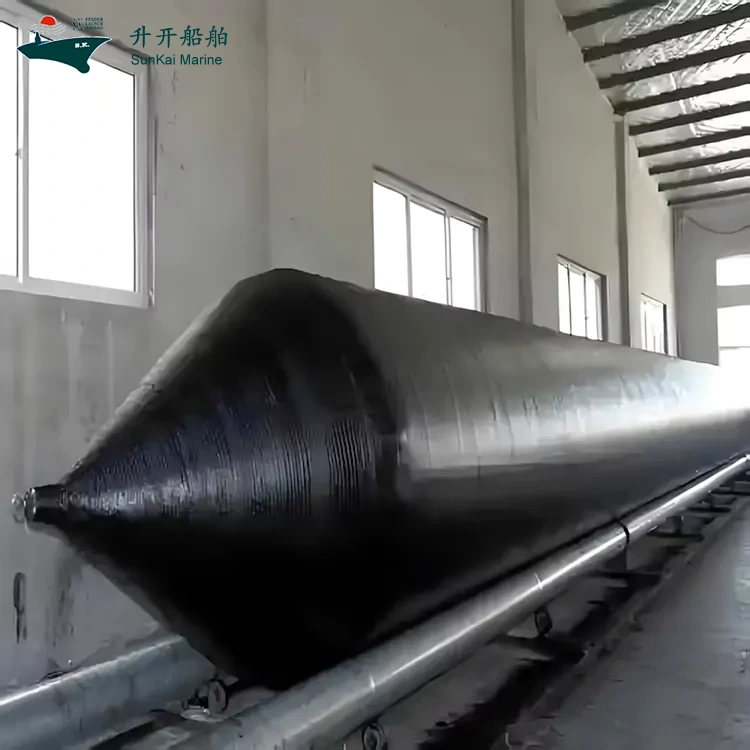
The Technical Advantages of Inflatable Rubber Airbags in Marine Salvage
Inflatable rubber airbags offer distinct benefits that make them indispensable for salvage professionals. Unlike traditional methods such as crane barges or floating dry docks, airbags provide flexibility in deployment and can operate in shallow waters where large vessels cannot navigate. The table below compares key performance factors:
| Feature | Inflatable Rubber Airbags | Traditional Hard Floats |
|---|---|---|
| Deployment Speed | Rapid, no heavy machinery needed | Slow, requires crane setup |
| Water Depth Adaptability | Works in shallow and deep water | Limited by draft requirements |
| Storage Footprint | Compact when deflated | Large, permanent structure |
| Load Distribution | Even pressure across hull | Point loading risks damage |
| Cost Efficiency | Low operational cost | High mobilization expense |
SunKai engineers these airbags using multi-layer reinforced rubber compounds that resist abrasion from sharp wreckage and maintain flexibility in cold water. Each unit undergoes rigorous pressure testing to ensure performance at depths where external water pressure exceeds several atmospheres.
Why Marine Salvage Experts Trust Inflatable Rubber Airbags
The preference for inflatable rubber airbags stems from their proven track record in real-world salvage scenarios. When a fishing vessel sinks in awkward position or a barge capsizes in a shipping channel, time is critical. Salvage masters choose airbags because they can be:
-
Positioned precisely under the hull using diver guidance
-
Inflated progressively to control ascent rate
-
Deflated quickly for repositioning if the angle shifts
-
Reused immediately on subsequent lifts
SunKai provides custom solutions including high-capacity airbags rated for lifts exceeding 100 tons, complete with safety valves that prevent over-inflation during ascent—a common concern when pressure decreases as the object rises.
Frequently Asked Questions About Inflatable Rubber Airbags
Q: How do inflatable rubber airbags generate enough lift to raise sunken ships?
A: Inflatable rubber airbags operate on the principle of displacement. When submerged and inflated with compressed air, each airbag displaces a volume of water equal to its inflated size. Since seawater weighs approximately 64 pounds per cubic foot, a single SunKai airbag with a 5-cubic-meter volume generates over 5 tons of lifting force. Salvage operations connect multiple airbags in parallel arrays to distribute lift across the wreckage, achieving total capacities of several hundred tons. The airbags inflate gradually, allowing salvage teams to monitor ascent angles and adjust individual bag pressures to keep the vessel level during recovery.
Q: What makes SunKai airbags suitable for deep water salvage applications?
A: SunKai manufactures inflatable rubber airbags using high-tensile synthetic fabric reinforcement embedded in specialized rubber compounds that remain flexible at depth. Unlike standard lift bags that collapse under pressure, SunKai airbags incorporate pressure compensation systems that maintain shape and lift efficiency even at depths exceeding 30 meters. The external rubber layers resist ozone degradation and saltwater corrosion, while internal coatings prevent air permeability. Each airbag includes multiple independent chambers with check valves, ensuring that if one section is damaged by debris, the remaining chambers retain lift capacity for controlled emergency ascent.
Q: How do salvage teams control the ascent speed using inflatable rubber airbags?
A: Precision ascent control is achieved through SunKai's manifold valve systems that regulate airflow into each inflatable rubber airbag. Experienced divers attach vented lift lines that allow surface crews to bleed air from bags if ascent becomes too rapid. Modern SunKai airbags feature remote-operated dump valves that trigger automatically if preset depth rates are exceeded, preventing runaway ascents that could endanger divers or cause the wreckage to pendulum. By adjusting inflation in sequential stages, salvage masters raise vessels in controlled increments, typically 1-2 meters per minute, allowing time for the hull to stabilize and for crews to inspect for snagging hazards.
Contact SunKai for Your Marine Salvage Requirements
When your project demands proven performance from inflatable rubber airbags, trust the expertise of SunKai. Our engineering team provides technical support from concept through completion, including load calculations, airbag selection guidance, and on-site consultation. Contact SunKai today to discuss your marine salvage challenge and receive a customized lifting solution that meets your exact specifications.