

What Role Does Marine Airbag Play in Offshore Wind Farm Installation?
2026-09-01
Before you specify any launching or recovery method for offshore foundations, answer this question: "Does my installation schedule allow for a three day weather window, or do I need a solution that operates in marginal sea states?" A Marine Airbag is not a generic lifting device. It is a site specific engineering tool that can drastically reduce the need for heavy lift vessels—but only if you understand the seabed conditions, the tidal range, and the structural limits of the foundation itself.
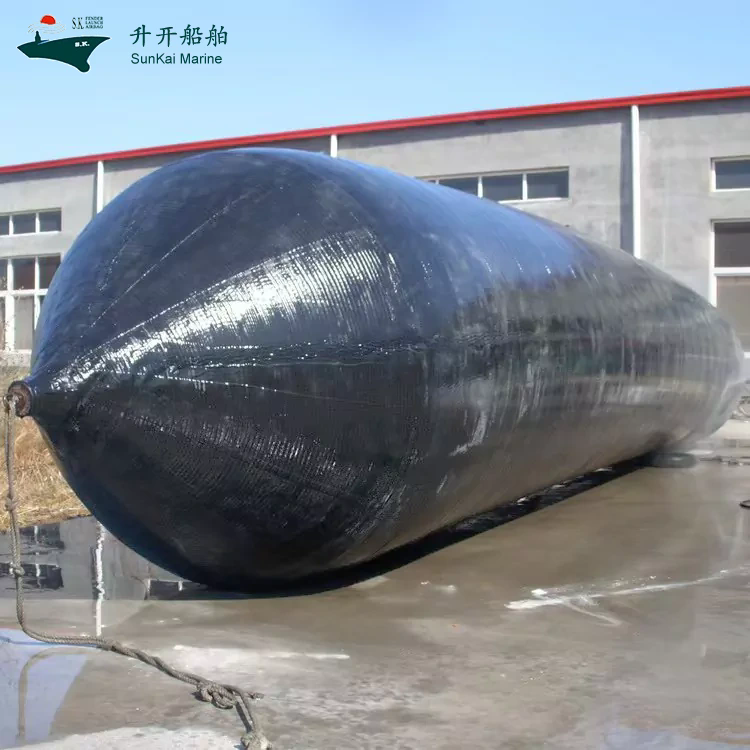
1. What Specific Installation Task Does the Airbag Replace or Augment?
In most offshore wind projects, the critical path is the transfer of the foundation (monopile or jacket) from the transport barge to the seabed. Traditional methods rely on a sheerleg crane or a floating crane vessel to lift the foundation and lower it to the seabed. This requires calm seas and precise dynamic positioning of the vessel. A Marine Airbag system provides an alternative: the foundation is launched directly from the barge using a controlled roll or slide, and the airbag acts as a flotation and positioning device to guide the foundation to its target location. This method eliminates the need for a crane vessel for the launching phase. In our factory, we manufacture Marine Airbag products with a modular construction that allows for rapid deployment. Qingdao SunKai Marine Supplies Co., Ltd. has supplied airbag systems for projects in the North Sea and the Taiwan Strait where the tidal range made crane vessel operations prohibitively expensive.
The role is therefore displacement and positioning, not lifting. When evaluating a Marine Airbag, you need to ask: what is the maximum lateral load the airbag can withstand during the launch, and how does the airbag maintain stability as the foundation transitions from a horizontal to a vertical position?
2. How Do You Assess Seabed Suitability and Avoid the "Soft Mud" Trap?
The most common failure mode in airbag launching is not airbag burst—it is seabed penetration. If the seabed is too soft, the foundation (especially a heavy jacket) will sink into the mud before it can be properly positioned. This creates a recovery nightmare. To assess suitability, you need a geotechnical survey that provides the bearing capacity of the seabed at the launch location. The table below shows the recommended Marine Airbag configuration based on seabed bearing capacity.
| Seabed bearing capacity (kPa) | Recommended airbag diameter (mm) | Number of airbags per foundation | Expected ground contact pressure (kPa) |
| < 30 (soft clay / silt) | 2000 | 6 – 8 | 25 – 35 |
| 30 – 50 (medium dense sand) | 1800 | 4 – 6 | 35 – 45 |
| 50 – 80 (dense sand / gravel) | 1600 | 3 – 4 | 45 – 60 |
| > 80 (rock or stiff clay) | 1400 | 2 – 3 | 60 – 80 |
In our factory, we provide a launch simulation model that incorporates the seabed bearing capacity, the foundation geometry, and the tidal current. This model calculates the required airbag pressure and the expected sinkage. Qingdao SunKai Marine Supplies Co., Ltd. offers a site specific launch plan as part of the Marine Airbag procurement package. We recommend that you request a copy of the geotechnical report from your survey contractor and provide it to the airbag supplier before finalizing the design.
3. What Is the Realistic Risk of Airbag Damage, and How Do You Mitigate It?
Damage to a Marine Airbag during launch is rare when the system is correctly specified, but the consequence is severe. A damaged airbag during launch can cause the foundation to tilt, leading to structural damage to the foundation itself. The primary risk factors are sharp objects on the seabed (debris, boulders), excessive rolling motion of the barge, and exceeding the rated working pressure. Mitigation involves three layers: a protective outer layer on the airbag (typically high grade rubber with reinforced fabric), a pressure relief system that vents automatically if the pressure exceeds the safe limit, and a diver inspection protocol before each deployment. In our factory, we test each Marine Airbag to 1.5 times the rated working pressure and conduct an ultrasonic inspection of the fabric layers. Our Qingdao SunKai Marine Supplies Co., Ltd. provides a field repair kit and a rapid response service for emergency repairs.
Procurement note: When evaluating a supplier, ask for the repair history. A supplier that has never had a failure may not have a robust field repair protocol. Our factory maintains a log of all field incidents and has developed a standard operating procedure for each type of damage.
4. How Does the Tidal Cycle Affect the Launch Sequence, and What Is the Risk of Stuck Foundation?
An offshore launch is not a continuous operation. The Marine Airbag system must be deployed at a specific point in the tidal cycle to ensure that the foundation lands on the seabed at the correct angle. The optimal window is typically during slack tide, when the current is minimal. If the launch is attempted during peak current, the foundation can drift and the airbag can become twisted. The recommended tidal window for a safe launch is 30 minutes before and after high water (or low water) when the current speed is below 0.5 knots. If the foundation becomes stuck due to seabed suction or incorrect positioning, the recovery operation can take 24 to 48 hours and may require a diver team and additional lifting equipment. Our project planning team recommends including a recovery contingency in your schedule.
Frequently Asked Questions About Marine Airbag Systems
Summary for Project Managers and Procurement Engineers
A Marine Airbag is not a commodity item that can be selected based on price alone. It is an engineered solution that depends on seabed conditions, tidal cycles, and foundation design. The role it plays in offshore wind installation is risk reduction—it reduces the reliance on expensive crane vessels and allows operations to continue in marginal weather. However, it also introduces new risks: seabed penetration, airbag damage, and tidal scheduling. The key to a successful deployment is a thorough site assessment, a correctly specified airbag system, and a well trained launch crew.
Qingdao SunKai Marine Supplies Co., Ltd. provides a complete system that includes the Marine Airbag, launch simulation, and on site support. We have supplied systems for monopile and jacket installations in water depths ranging from 10 to 60 meters.