

What lighting and marking standards apply to mid size navigation buoys internationally
2026-04-14
When navigating coastal and inland waters, Mid Size Navigation Buoys play a critical role in marking channels, hazards, and regulated areas. Understanding the international lighting and marking standards for these buoys is essential for maritime safety. As a trusted name in marine aids to navigation, SunKai ensures that all Mid Size Navigation Buoys meet or exceed global requirements set by the International Association of Marine Aids to Navigation and Lighthouse Authorities (IALA).
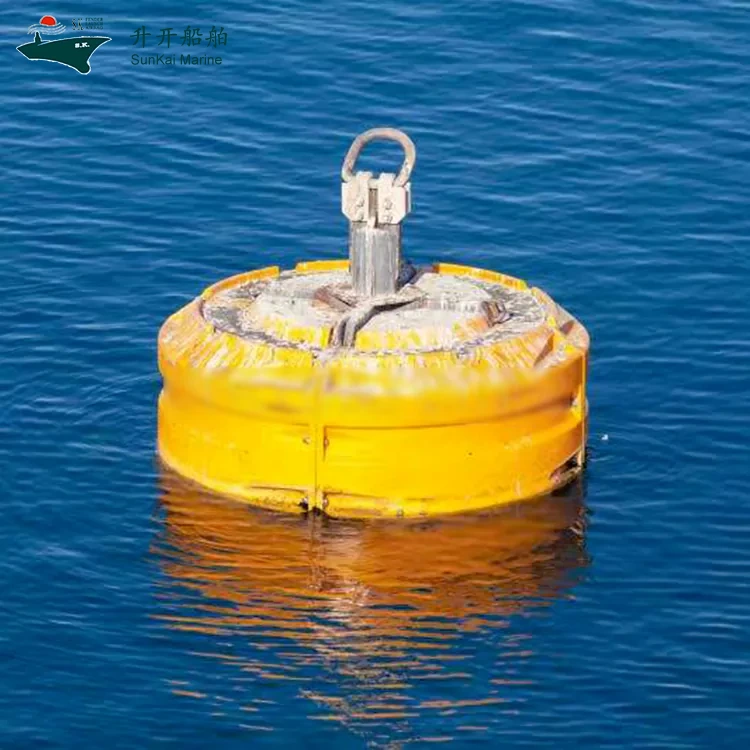
Core international standards for mid size navigation buoys
The IALA Maritime Buoyage System defines two regions (A and B) with minor color differences for lateral marks, but consistent rules apply worldwide for Mid Size Navigation Buoys regarding shape, color, topmark, and light characteristics.
| Feature | Requirement for Mid Size Navigation Buoys |
|---|---|
| Light color | Red, green, white, or yellow as per buoy function |
| Rhythm | Fixed, flashing, occulting, quick flashing, or Morse code |
| Range | Typically 2 to 5 nautical miles |
| Structure | Rigid or inflatable, visible from all directions |
| Topmark | Conical, cylindrical, or X-shaped where applicable |
Light characteristics by buoy type
| Buoy Type | Light Color | Rhythm Example | Application |
|---|---|---|---|
| Port lateral | Red | Flashing 2+1 | Left side of channel (Region A) |
| Starboard lateral | Green | Flashing 2+1 | Right side of channel (Region A) |
| Cardinal north | White | Very quick flashing | North of hazard |
| Isolated danger | White | Flashing group (2) | Around small hazard |
| Safe water | White | Iso or occulting | Mid-channel or fairway |
| Special mark | Yellow | Fixed or flashing | Military, cables, or recreation |
FAQ – Mid Size Navigation Buoys common questions
What light color and rhythm are required for a safe water mid size navigation buoy
A safe water Mid Size Navigation Buoy must display a white light with an isophase, occulting, or long flashing rhythm (e.g., one flash every 10 seconds). The light range should be at least 2 nautical miles. The buoy itself is red and white vertical stripes with a spherical or red spherical topmark. These buoys indicate navigable water around mid-channel or landfall points.
How do I determine the correct retroreflective material for mid size navigation buoys
Mid Size Navigation Buoys require retroreflective material that matches the buoy’s daytime color and light characteristic. For red buoys, use red reflective tape; for green buoys, green tape; for yellow or white buoys, silver or white reflective tape is acceptable. The material must meet IALA Recommendation O-117 and be visible from at least 500 meters under spotlight. SunKai provides high-durability reflective sheets tested for saltwater and UV exposure.
Do mid size navigation buoys need synchronized lights in a channel
In narrow or complex channels, Mid Size Navigation Buoys may benefit from synchronized lights to avoid confusion. Synchronization is not mandatory under IALA but is recommended for port approach lanes with closely spaced buoys. Flashing rhythms can be electronically synchronized to flash simultaneously or in sequence. This practice reduces misidentification risk and improves pilot confidence. SunKai offers GPS-synchronized LED lanterns for such applications.
Additional marking requirements
Beyond lighting, Mid Size Navigation Buoys must display:
-
Daymarks: Specific shapes and colors visible from 1 to 3 nautical miles
-
Topmarks: Small shapes on top of the buoy body for redundancy
-
Radar reflectors: Required for buoys in shipping lanes with heavy traffic
-
AIS capability: Increasingly mandatory in high-risk zones (IALA Guideline G1117)
SunKai integrates these features into its Mid Size Navigation Buoys while maintaining compliance with IALA, USCG, and national waterway authority standards. Each buoy undergoes photometric and color testing before deployment.
Contact us
For a detailed compliance checklist or to discuss custom lighting configurations for your Mid Size Navigation Buoys, contact SunKai today. Our engineers provide free IALA gap analysis and buoy specification sheets. Reach us through the website contact form or email support with your project requirements.