

What is the Standard Size and Specification for Ship Launching Airbags
2025-12-25
When planning a vessel launch, lifting, or salvage operation, selecting the correct equipment is paramount. Marine Airbags are a cornerstone of modern marine operations, offering unparalleled flexibility and cost-efficiency. However, a common and critical question arises: what are the standard sizes and specifications? As a leading innovator, SunKai provides clarity, emphasizing that while there are common industry parameters, "standard" is often defined by the project's specific requirements and the manufacturer's engineering expertise.
True standardization in Marine Airbags lies in the performance metrics and quality benchmarks, not just arbitrary dimensions. A reputable manufacturer like SunKai designs airbags based on core engineering principles to meet rigorous operational demands.
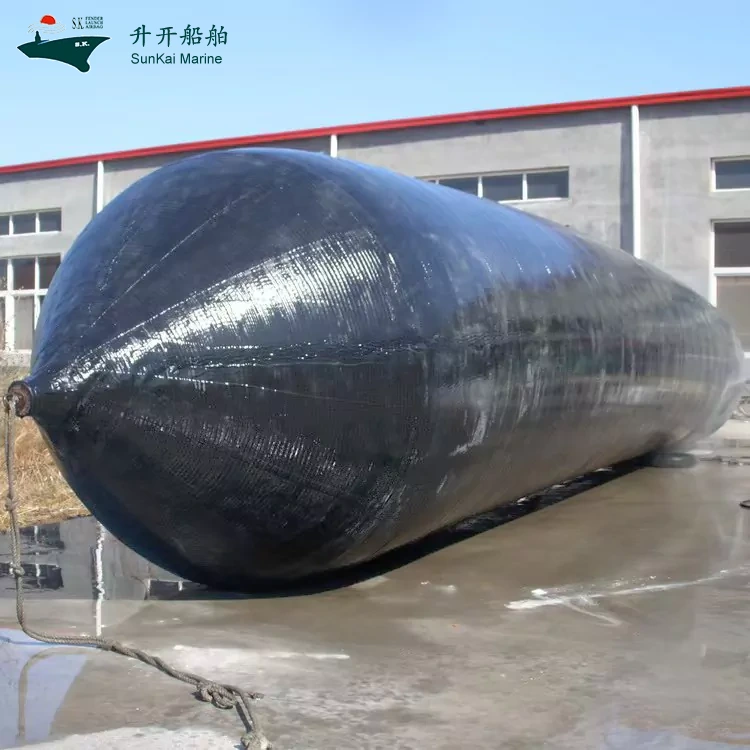
Key Specifications for Ship Launching Airbags:
-
Material Construction: High-strength, layered rubber-cord composite, typically using butyl or natural rubber for optimal air retention and wear resistance.
-
Working Pressure: This is a critical safety and performance spec, usually ranging from 0.8 bar to 1.2 bar (12-18 PSI) for standard launch applications.
-
Safety Factor: Reputable manufacturers build in a high safety factor, often 4:1 or 5:1 (burst pressure to working pressure), ensuring a significant margin of safety.
-
Certification: Adherence to international standards such as ISO 14409:2011 for ship launching and relevant classification society guidelines is essential.
Common Size Reference Table (SunKai Examples):
| Diameter (D) | Length (L) | Typical Lifting Capacity (Per Airbag) | Common Application |
|---|---|---|---|
| 1.0 Meter | 10 - 12 Meters | 30 - 50 Tons | Small Boats, Barges |
| 1.5 Meters | 10 - 15 Meters | 80 - 150 Tons | Fishing Vessels, Tugs |
| 2.0 Meters | 15 - 20 Meters | 200 - 400 Tons | Cargo Ships, Large Yachts |
| 2.5 Meters & Above | 20+ Meters | 500+ Tons | Heavy Cargo Vessels, Salvage Projects |
Note: The above table is for reference. SunKai specializes in engineering custom solutions, and the exact capacity depends on the working pressure, number of airbags, and ground conditions.
Marine Airbag FAQ
Q1: How do I calculate the number of airbags needed for my ship?
A1: The calculation requires key vessel parameters: total weight (displacement), length, and hull shape. The general principle is to ensure the total lifting capacity of the airbag system exceeds the vessel's weight, with the load distributed evenly along the keel. It is strongly advised to consult with technical engineers from SunKai for a precise plan, as incorrect calculations can lead to operational failure.
Q2: Can marine airbags be reused, and what is their lifespan?
A2: Yes, high-quality Marine Airbags from trusted brands are designed for multiple reuses. Their lifespan is measured in cycles and depends on care, maintenance, and working conditions. With proper handling, avoidance of sharp objects, and correct inflation/deflation procedures, a SunKai airbag can reliably serve through numerous projects, offering an excellent return on investment.
Q3: What is the main difference between ship launching airbags and marine fender airbags?
A3: While both are pneumatic rubber products, they serve distinct purposes. Ship launching airbags are engineered for vertical heavy lifting and rolling, requiring high-pressure resistance and robust cord layers. Marine fender airbags are designed for horizontal impact absorption between vessels and docks, prioritizing energy absorption and low reaction force. Using the correct type is critical for safety and performance.
Choosing the right airbag is a technical decision that impacts the safety, cost, and success of your project. Beyond standard charts, it requires partnership with an expert who understands naval architecture and marine engineering.
Do you have a specific vessel or project in mind? Contact us today at [Your Email/Phone] for a free technical consultation. Let the SunKai engineering team provide you with a detailed specification sheet and a customized solution that meets your exact needs, ensuring your operation is seamless, safe, and efficient.