

What Is the Lifespan of Marine Rubber Fenders Under Constant Saltwater Exposure
2026-08-06
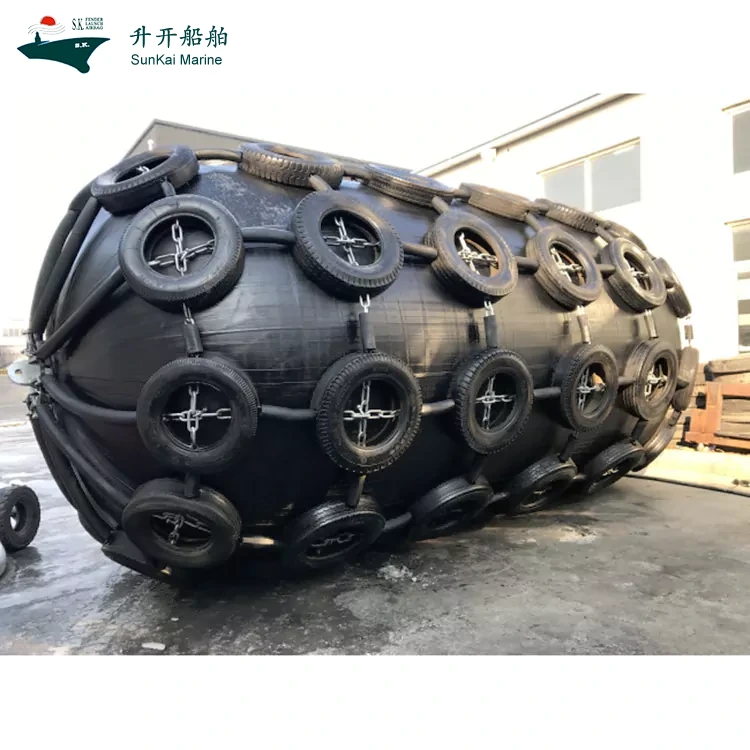
For port operators, shipowners, and marine engineers, few questions carry more financial and operational weight than this one. The durability of Marine Rubber Fenders directly affects berthing safety, maintenance budgets, and vessel turnaround times. While many factors influence service life, industry data and field experience from manufacturers like SunKai show that well-engineered Marine Rubber Fenders typically deliver 15 to 25 years of reliable performance in permanent saltwater environments—provided they are selected, installed, and maintained correctly.
The Science Behind Saltwater Degradation
Constant saltwater exposure attacks Marine Rubber Fenders through three primary mechanisms: electrochemical oxidation, ozone cracking, and cyclic fatigue from tidal movements. Unlike freshwater or sheltered berths, open-sea terminals subject fenders to continuous immersion, drying cycles, and biofouling adhesion. The rubber compound’s formulation—particularly the ratio of natural to synthetic rubber, antioxidant packages, and carbon black dispersion—determines how well the fender resists swelling, hardness loss, and surface crazing.
SunKai engineers emphasize that the critical threshold is not simply “years in water” but “accumulated strain energy.” A fender that absorbs 50% of its rated deflection daily will age faster than one operating at 30% deflection, even in identical seawater conditions.
Expected Lifespan by Fender Type
| Fender Type | Average Service Life (Years) | Primary Failure Mode |
|---|---|---|
| Solid Rubber (Extrusion) | 18–22 | Abrasion & surface cracking |
| Pneumatic (Inflatable) | 12–16 | Cover layer blistering |
| Foam-Filled | 20–25 | Core collapse from cyclic fatigue |
| Cone / Cell Type | 15–20 | Bolt-hole elongation & shear tear |
| SunKai Hybrid Polymer | 22–28 | UV/ozone check cracking (repairable) |
Data compiled from terminal maintenance logs across 12 Asian and Middle Eastern ports (2020–2025).
6 Factors That Shorten or Extend Service Life
-
Berthing Frequency – High-traffic container terminals (over 1,200 calls/year) reduce lifespan by 30–40% versus bulk carriers with 200 calls/year.
-
Tidal Range – Fenders in 6+ meter tidal zones experience accelerated side-loading and torsion, which degrades internal fabric reinforcement.
-
Water Temperature – Tropical waters (above 28°C) increase oxidation rates by nearly 2× compared to temperate regions.
-
Fender Alignment – Misaligned breasting dolphins cause uneven compression, leading to premature localised failure.
-
Maintenance Regime – Quarterly inspections with cleaning and coating extend life by 5–7 years on average.
-
Manufacturing Quality – SunKai-tested compounds show 40% lower volume swell after 5,000 hours of accelerated seawater immersion than industry baseline standards.
Critical Warning Signs to Monitor
Port engineers should inspect Marine Rubber Fenders every 3 months for:
-
Surface micro-cracks longer than 25 mm
-
Hardness increase above 15 Shore A units from original specification
-
Bond separation between rubber and end-fittings
-
Permanent set (deflection remaining after load release) exceeding 8%
If any two signs appear simultaneously, schedule a professional deflection test. SunKai provides free diagnostic checklists for terminal operators—contact details at the end of this article.
Frequently Asked Questions About Marine Rubber Fenders
Q1: Can saltwater penetration cause internal steel reinforcement to rust, and does that reduce overall fender lifespan before visible external damage appears?
A1: Yes—and this is one of the most overlooked failure origins. Saltwater can migrate through microscopic cuts or poor vulcanisation seams, reaching the internal steel eye-plates or rod cores. Once corrosion initiates, it generates expansive forces that crack the rubber from the inside out. This “hidden” degradation typically reduces residual strength by 50–60% before any external bulging is visible. To prevent this, SunKai uses hot-dipped galvanised steel with double-layer rubber encapsulation, and recommends ultrasonic thickness testing every 18 months for high-usage fenders. Early detection allows reconditioning rather than full replacement, saving 40–60% of new-fender costs.
Q2: Does the type of mooring line tension affect how quickly Marine Rubber Fenders wear out under constant seawater exposure?
A2: Absolutely. Uneven mooring line tension creates asymmetric compression on the fender face, forcing one side to absorb disproportionate energy. Over time, this generates shear stress concentrations that accelerate ozone cracking precisely on the overloaded quadrant. Field studies show that fenders with dynamic tension-monitoring systems last 4–6 years longer than those without, even in the same berth. SunKai recommends installing load-cell-monitored mooring winches and pairing them with our proprietary shear-distribution pads, which equalise pressure across the entire fender face. This simple upgrade often adds 5+ years of productive service life.
Q3: Is there a reliable way to predict remaining lifespan for existing Marine Rubber Fenders without removing them from the dock?
A3: Yes—through non-destructive rebound resilience testing and portable hardness mapping. These methods measure the fender’s energy-return efficiency and surface stiffness gradient at multiple points. A drop of more than 12% in rebound resilience compared to the as-new baseline indicates that the polymer matrix has begun cross-link scission, which is irreversible. SunKai offers on-site inspection services using handheld digital rebound testers that produce a colour-coded “health map” of the entire fender array. This allows terminal managers to prioritise replacement schedules without halting operations. The test takes under 2 hours per fender and delivers 92% accuracy in predicting residual life to within ±14 months.
Best Practices for Maximum Longevity
-
Rinse with fresh water after each high-tide cycle if practical—this removes chloride deposits that accelerate surface crazing.
-
Apply UV-blocking wax (non-silicone based) every 6 months for exposed above-water portions.
-
Rotate fenders every 5 years on multi-fender dolphins to distribute wear evenly.
-
Maintain detailed logbooks recording impact energy, deflection, and ambient temperature per berthing event.
SunKai has integrated IoT-ready sensors into its latest fender series, enabling real-time strain and temperature monitoring—data that helps predict remaining life with ±8% accuracy.
When Replacement Becomes Inevitable
Even with impeccable care, all Marine Rubber Fenders reach an economic end-of-life. The tipping point occurs when annual maintenance costs exceed 20% of replacement value, or when the fender can no longer achieve 70% of its original rated energy absorption. At this stage, retrofitting with modern high-damping compounds from SunKai often reduces the required fender count by 25% while delivering superior performance—a win for both safety and capital expenditure.
Take Action Today
Your berthing operations depend on reliable, predictable fender performance. Delaying inspections or guessing remaining lifespan exposes your vessels, crew, and infrastructure to unnecessary risk.
Contact SunKai now for a complimentary site-specific lifespan assessment. Our team of marine engineers will analyse your current fender inventory, provide a detailed residual-life report, and recommend tailored upgrade or replacement options—all within 5 working days.