
How Marine Airbag Withstands Seawater, UV, and Heavy Object Weight?
2026-10-21
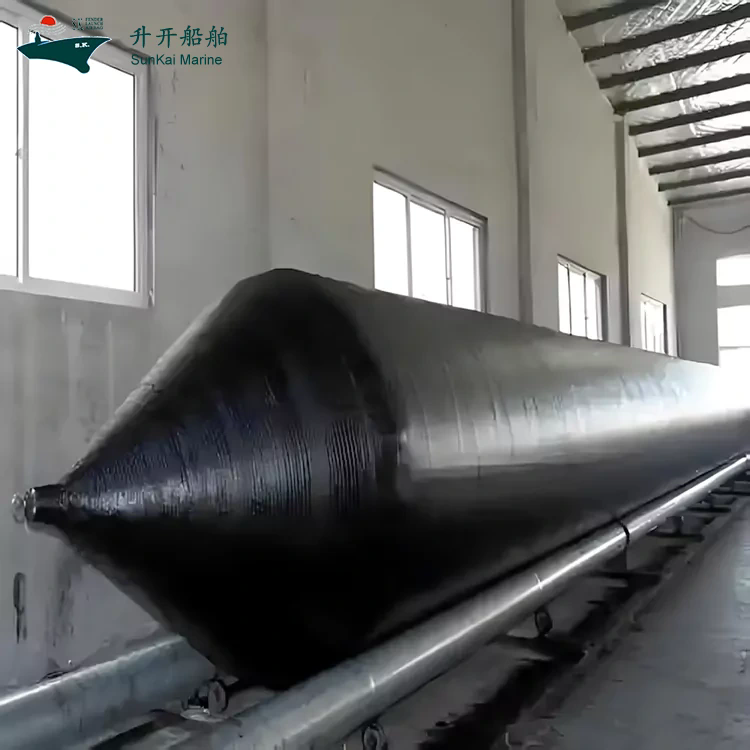
A shipyard operations supervisor compares the service records of two batches of Marine Airbag used for launching a 5,000-ton vessel. Batch A has completed 15 launch cycles over three years and is still in service. Batch B failed after 4 cycles, with visible bulging and delamination at the end fitting. The supervisor investigates the difference. The rubber compound in Batch A contains an anti-ozonant and a UV stabilizer. The cord layers are dipped in a resorcinol-formaldehyde latex adhesive before calendering. Batch B uses a standard rubber compound without UV protection and a mechanical bonding process. The difference in service life is not an accident. It is the result of specific material and process choices. This guide explains how a marine airbag withstands seawater, UV, and heavy loads.
1. How Does the Rubber Compound Resist Seawater and UV Degradation?
The outer rubber layer of a Marine Airbag is exposed to seawater, salt spray, and direct sunlight. Seawater contains chloride ions that attack the rubber polymer chains. UV radiation breaks the carbon-carbon bonds and causes surface cracking. The rubber compound must include specific additives to resist both. The table below shows the key additives and their function.
| Additive | Function | Typical concentration (phr) | Performance benefit |
| Carbon black (N330) | Reinforcement, UV absorption | 40 – 50 | Increases tensile strength and tear resistance |
| Anti-ozonant (6PPD) | Prevents ozone cracking | 2 – 3 | Extends life in coastal environments |
| UV stabilizer (HALS) | Absorbs UV radiation | 1 – 2 | Prevents surface cracking and chalking |
| Wax | Forms a protective barrier | 1 – 2 | Reduces ozone attack at the surface |
| Antioxidant (TMQ) | Prevents thermal oxidation | 1 – 2 | Extends life at high temperatures |
In our factory, we compound the rubber for Marine Airbag units with a minimum of 2 phr 6PPD and 1.5 phr HALS. The compound is mixed in an internal mixer and calendered into sheets. We test the compound for tensile strength, elongation at break, and ozone resistance according to ASTM D1149. The table below shows the typical test results for our seawater-resistant compound.
| Property | Test method | Typical value | Minimum requirement |
| Tensile strength | ASTM D412 | 18 – 22 MPa | 15 MPa |
| Elongation at break | ASTM D412 | 450 – 550% | 400% |
| Ozone resistance (50 pphm, 40°C, 72h) | ASTM D1149 | No cracks | No cracks |
| Salt spray resistance (500h) | ASTM B117 | No degradation | No degradation |
| UV resistance (1000h QUV) | ASTM G154 | ΔE < 3 | ΔE < 5 |
Qingdao SunKai Marine Supplies Co., Ltd. has been manufacturing Marine Airbag units for over 12 years. Our factory tests every batch of rubber compound for ozone and UV resistance before production.
2. How Do the Cord Layers Support Heavy Object Weight?
The load-bearing capacity of a Marine Airbag is determined by the cord layers. The cords are made from high-tenacity synthetic fiber, such as polyester or nylon. They are arranged in multiple layers at a specific angle to the axis of the bag. The angle determines how the bag deforms under load. The rubber bonds the cords together and transfers the load between them. The table below shows the cord layer configuration for different load capacities.
| Airbag diameter (m) | Number of cord layers | Cord angle (degrees) | Working pressure (MPa) | Load capacity per meter (ton/m) |
| 1.0 | 4 | 30 – 35 | 0.08 | 8 – 10 |
| 1.2 | 5 | 30 – 35 | 0.10 | 12 – 15 |
| 1.5 | 6 | 30 – 35 | 0.12 | 18 – 22 |
| 1.8 | 7 | 30 – 35 | 0.15 | 25 – 30 |
| 2.0 | 8 | 30 – 35 | 0.18 | 32 – 38 |
The bonding between the cord and the rubber is critical. If the bond is weak, the cords can separate from the rubber under load, causing a bulge or a blowout. In our factory, we use a resorcinol-formaldehyde latex (RFL) adhesive to treat the cords before calendering. The RFL coating provides a strong chemical bond between the fiber and the rubber. We test the bond strength using a peel test according to ASTM D413. The minimum acceptable peel strength is 8 N/mm. Qingdao SunKai Marine Supplies Co., Ltd. has a 100 percent bond strength inspection on every production batch.
3. What Field Practices Extend the Service Life of a Marine Airbag?
Even the best Marine Airbag can fail prematurely if it is used incorrectly. The three most important field practices are pressure control, surface preparation, and proper storage. The table below shows the recommended practices and their effect on service life.
| Field practice | Recommendation | Effect on service life |
| Working pressure | Do not exceed 1.25 times the rated pressure | Prevents overstress and cord rupture |
| Ground surface | Remove sharp stones and debris | Prevents punctures and cuts |
| Rolling distance | Limit to 50 meters per cycle | Reduces heat buildup and wear |
| Storage | Store in a dry, shaded area; deflate to 10% pressure | Prevents UV degradation and deformation |
| Inspection | Inspect before each use for cuts, bulges, and delamination | Detects damage before failure |
Shipyard supervisor's note: In our experience, the most common cause of premature airbag failure is over-pressurization. The operator inflates the bag to the maximum pressure to compensate for a heavy load, but the pressure exceeds the cord strength. The bag bulges and fails. The correct approach is to use the recommended pressure for the load and the number of bags. If the load is heavier than expected, add more bags rather than increasing the pressure. In our factory, we provide a load calculation chart with every Marine Airbag order. The chart shows the recommended pressure and the number of bags for different vessel weights.
4. How Should the Airbag Be Inspected and Maintained?
Regular inspection and maintenance are essential for safe operation. The inspection should be performed before each use and after every 5 cycles. The table below shows the inspection checklist.
| Inspection item | Method | Acceptance criteria |
| Surface condition | Visual inspection | No cuts deeper than 2 mm; no exposed cords |
| End fittings | Visual and tactile inspection | No cracks; no loose bolts |
| Shape | Measure diameter at 3 points | Diameter variation < 5% |
| Pressure retention | Inflate to rated pressure; wait 30 min | Pressure drop < 5% |
| Delamination | Tap with a small hammer | No dull sound (indicates separation) |
In our factory, we provide a maintenance log with every Marine Airbag. The log allows the operator to record the date, the cycle count, the pressure, and the inspection results. We also offer a repair kit for minor surface damage. SunKai recommends that the airbag be retired after 20 to 30 cycles, depending on the load and the operating conditions.
Frequently Asked Questions About Marine Airbag Durability
Summary for Shipyard Operations Supervisors
Marine Airbag durability depends on three factors: the rubber compound, the cord layer bonding, and the field practices. The rubber compound must contain anti-ozonants and UV stabilizers to resist seawater and sunlight. The cord layers must be treated with an RFL adhesive to bond with the rubber and to support heavy loads. The field practices must control the pressure, prepare the ground surface, and store the airbag properly. By understanding these factors, shipyard supervisors can extend the service life of their airbags and ensure safe launching operations. Qingdao SunKai Marine Supplies Co., Ltd. has been manufacturing Marine Airbag units for over 12 years and provides full technical support for our customers.
Qingdao SunKai Marine Supplies Co., Ltd. manufactures Marine Airbag units with seawater-resistant rubber compounds, RFL-treated cord layers, and pressure-tested end fittings. We provide load calculation charts, inspection checklists, and repair kits for all of our products.