How Do Environmental Conditions Like Tide and Seabed Slope Affect Ship Launching Safety Airbags Performance
2026-04-20
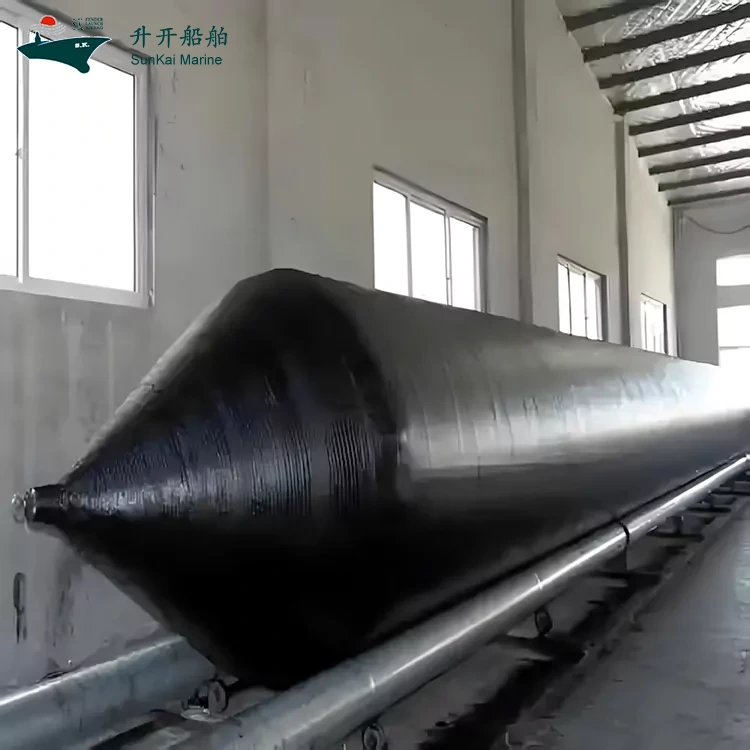
When deploying Ship Launching Safety Airbags such as those manufactured by SunKai, environmental factors are not minor variables—they are primary determinants of launch success. Tide levels and seabed slope directly influence airbag rolling stability, internal pressure distribution, and hull stress. Understanding these interactions is critical for any marine operation aiming to prevent airbag rupture or vessel structural damage.
The Impact of Tide on Airbag Performance
Tidal changes affect water buoyancy support and the timing of hull contact with airbags. During low tide, the hull exerts maximum weight on the airbags, increasing friction and the risk of uneven compression. As tide rises, partial buoyancy reduces airbag load, which can cause sudden rolling or shifting if the launch slope is not adjusted.
The Role of Seabed Slope
Seabed slope determines the directional force vector acting on the Ship Launching Safety Airbags. A slope that is too steep increases longitudinal gravitational pull, raising the risk of airbag displacement. A slope that is too gentle may fail to overcome static friction, requiring excessive inflation pressure. The optimal range for most airbag launches is between 1.5% and 3.5%.
| Environmental Factor | Effect on Airbag Performance | Recommended Mitigation |
|---|---|---|
| Low tide (minimal buoyancy) | High compression, increased wear | Reduce hull weight or add airbags |
| Rising tide (partial buoyancy) | Risk of airbag shifting | Secure airbags with lateral restraints |
| Steep seabed slope (>4%) | Excessive longitudinal force | Use braking systems or reduce launch speed |
| Gentle seabed slope (<1%) | Insufficient self-launch | Apply external pulling or increase airbag pressure |
SunKai engineers recommend real-time tide monitoring and pre-launch seabed slope surveys. Using adjustable airbag arrays and dynamic pressure control systems, their Ship Launching Safety Airbags maintain stable performance across a wide range of coastal environments.
Ship Launching Safety Airbags FAQ
How does low tide specifically increase the risk of airbag failure during a launch?
Low tide means little to no water buoyancy supporting the hull. The entire vessel weight presses directly onto the Ship Launching Safety Airbags, increasing internal pressure beyond normal operating ranges. This can cause airbag material fatigue, seam separation, or even explosive rupture if the pressure exceeds the rated capacity. Additionally, without water lubrication, friction between airbags and the hull bottom rises sharply, leading to uneven rolling and localized overheating. Operators should reduce hull loading or increase the number of airbags when launching at low tide.
What seabed slope is considered dangerous for using Ship Launching Safety Airbags and why?
A seabed slope exceeding 4% is generally considered dangerous for standard Ship Launching Safety Airbags. On such a steep incline, the gravitational component pulling the vessel downward becomes too strong for airbag friction and rolling resistance to control safely. This leads to uncontrolled acceleration, where the hull may overrun the forward airbags, causing them to be crushed or ejected sideways. Once an airbag is displaced, the hull can contact the ground directly, resulting in structural damage. For slopes above 4%, SunKai recommends using controlled winch-assisted launches or reducing launch weight significantly.
Can rising tide improve the performance of Ship Launching Safety Airbags automatically?
Rising tide does not automatically improve performance—it changes the load pattern. As water rises, buoyancy reduces the effective weight on the Ship Launching Safety Airbags, which lowers friction and allows easier rolling. However, this sudden load reduction can cause airbags to shift laterally if not secured, especially on uneven seabeds. The optimal approach is to plan launch timing so that the hull enters the water at mid-to-high tide but maintains steady airbag contact during the transition. SunKai provides tide-integrated launch protocols that adjust airbag pressure in real time to maintain stability throughout tidal changes.
Contact Us
For customized launch plans and high-performance Ship Launching Safety Airbags, reach out to SunKai today. Our engineering team provides site-specific tide and seabed slope analysis to ensure every launch is safe and efficient. Contact us via our official website or marine support hotline to discuss your next vessel launch project.