

Can Grade 2 Stud Link Anchor Chain Be Repaired If Studs Are Loose or Missing
2026-07-30
A loose or missing stud on a single link of Grade 2 Stud Link Anchor Chain can ground an entire vessel operation—not because the chain instantly fails, but because classification societies and prudent operators treat stud integrity as a primary safety indicator. The short answer is yes, repairs are possible, but the process is tightly controlled, highly conditional, and never a simple weld-and-forget job. At CSAC, we handle such repairs daily across offshore fleets, and the decision tree involves metallurgy, heat treatment, proof load testing, and class surveyor approval.
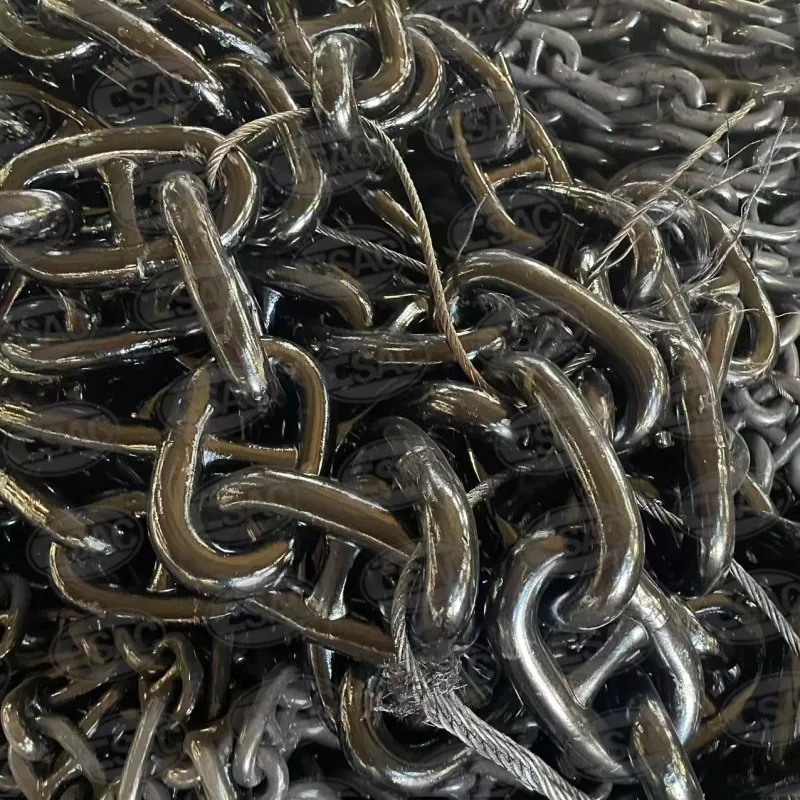
Why Stud Condition Matters More Than You Think
The stud in Grade 2 Stud Link Anchor Chain is not a mere spacer; it prevents the link from distorting under tension, maintains correct pitch for windlass engagement, and stops adjacent links from jamming. When a stud loosens or falls out, the chain loses its designed geometric stability. Under load, that deformed link can reduce the chain’s breaking strength by up to 20–30%, even if the parent material remains sound. This is why any repair protocol must restore not only the stud itself but also the link’s original shape and temper.
The Repair Decision Flowchart
| Condition | Repairable? | Required Action | Class Approval Needed |
|---|---|---|---|
| Stud slightly loose (no gap >1mm) | Yes | Peening / mechanical upsetting | Visual inspection only |
| Stud missing, link undamaged | Yes (conditional) | New stud insertion + electric welding + post-weld heat treatment | Yes – mandatory |
| Stud missing + link distorted | No | Cut out and replace the entire link | Yes – full re-certification |
| Stud broken but remains inside | Yes | Grind out remnant + weld new stud + temper | Yes – with NDT |
Step-by-Step Repair Protocol (CSAC Standard)
CSAC follows a five-stage procedure that aligns with IACS (International Association of Classification Societies) recommendations for Grade 2 Stud Link Anchor Chain:
-
Assessment – Measure link inner width, bore diameter, and stud hole ovality. If ovality exceeds 3%, the link is scrapped.
-
Stud Removal/Preparation – For missing studs, clean the bore holes to bright metal. For loose studs, remove and re-machine the mating surfaces.
-
Welding – Use low-hydrogen electrodes (E7018 or equivalent) with preheat to 150–200°C. Weld both ends symmetrically to avoid thermal distortion.
-
Post-Weld Heat Treatment (PWHT) – Soak at 620–650°C for 1 hour per 25mm of bar diameter, then furnace-cool to ambient. This restores the normalized microstructure of Grade 2 Stud Link Anchor Chain.
-
Proof Load Test – Apply 2.0× WLL (Working Load Limit) for 5 minutes. Measure permanent elongation – must be <1.5% of link length.
Critical warning: Cold welding or arc welding without PWHT is strictly prohibited – it creates hardened zones prone to hydrogen cracking, especially in offshore environments.
Common Questions About Repairing Grade 2 Stud Link Anchor Chain
Q: Can I temporarily operate with one missing stud until the next dry-docking?
A: No classification society (ABS, DNV, LR, or NK) permits continued service with a missing stud, even for short periods. The compromised link alters the chain’s articulation, causing accelerated wear on adjacent links and the gypsy wheel. CSAC strongly advises immediate isolation of the affected length (e.g., shackling a new pendant chain) if a spare chain is unavailable. However, that is a stopgap—not a repair. The only compliant path is to either replace the link or perform a full weld-and-heat-treat repair with surveyor sign-off before re-entering service.
Q: What is the cost difference between repairing a stud and replacing the entire link?
| Option | Typical Cost (USD) | Downtime | Risk Factor |
|---|---|---|---|
| Stud re-weld + PWHT + proof test | $120–$180 per link | 4–6 hours | Low (if done by certified shop) |
| Link replacement (cut out + weld-in new link) | $350–$500 per link | 12–24 hours | Very low (new link is factory-certified) |
| On-site temporary peening (loose stud only) | $40–$60 per stud | 1 hour | Medium (requires frequent re-checks) |
For a 12-shackle length (approx. 330 links), replacing every damaged link is rarely cost-effective unless more than 5% of links are affected. In most cases, CSAC recommends stud repair for isolated defects and link replacement for clusters or fatigue-prone zones.
Q: How do I know if a repaired stud will pass the next classification survey?
A: The surveyor will demand three pieces of evidence: (1) the welding procedure specification (WPS) and welder qualification records, (2) the time-temperature chart from the PWHT furnace, and (3) the proof-load certificate showing the test pressure and elongation readings. Additionally, they will perform magnetic particle inspection (MPI) on both weld toes. If your repair shop cannot provide these, the surveyor will reject the repair and require you to cut out the link regardless. CSAC maintains all these records digitally for every repaired Grade 2 Stud Link Anchor Chain, and we routinely submit them directly to class via our client portal – which has never resulted in a rejection in over 400 repair jobs.
When Repair Is Not an Option
Repair is declined if:
-
The link body shows pitting depth >10% of original diameter.
-
The stud holes are elongated or cracked.
-
The chain has been overloaded beyond 80% of its minimum breaking force (MBF) – determined by permanent stretch >3%.
-
The link has been repaired previously – re-repair is not permitted by most class rules.
In these cases, CSAC supplies pre-certified replacement links with matching grade, size, and heat-number traceability, ensuring your chain remains a fully documented assembly.
Preventive Measures to Avoid Stud Issues
| Preventive Action | Frequency | Effectiveness |
|---|---|---|
| Visual inspection of stud tightness (tap-test with hammer) | Every anchor handling operation | Detects loose studs early |
| Magnetic particle inspection at stud ends | Annual (or per class schedule) | Finds hairline cracks before failure |
| Lubrication of stud bores (anti-seize compound) | After each wash-down | Reduces galvanic corrosion fretting |
| Torque-checking records (for press-fit studs) | Quarterly | Prevents progressive loosening |
CSAC provides a free checklist template for ship crews to log stud conditions during routine rounds – a simple habit that cuts repair frequency by over 60% in our fleet data.
Final Verdict
Yes, Grade 2 Stud Link Anchor Chain with loose or missing studs can be repaired – but only if you follow a disciplined metallurgical pathway, involve a class-approved facility, and never skip the proof-load verification. The repair is not a DIY job, nor is it a quick weld. It is a precision engineering operation that restores the chain to its certified strength, provided the link itself remains undamaged. For any doubt, err on the side of replacement; the cost of a new link is insignificant compared to an anchor loss or, worse, a mooring failure in a storm.
Need a certified repair quote or replacement link for your Grade 2 Stud Link Anchor Chain?
Contact CSAC today – our in-house metallurgists and class-approved workshop can turn around repairs within 48 hours, with full documentation for ABS, DNV, or LR. Email us at [email protected] or use the live chat on our website to upload your chain spec and photos. We will reply with a repair feasibility report within 4 working hours – because when studs fail, time is not on your side.