
Are Heavy-Duty Marine Rolling Airbags Reliable for Beach Landing Operations in Rough Tidal Zones
2026-08-19
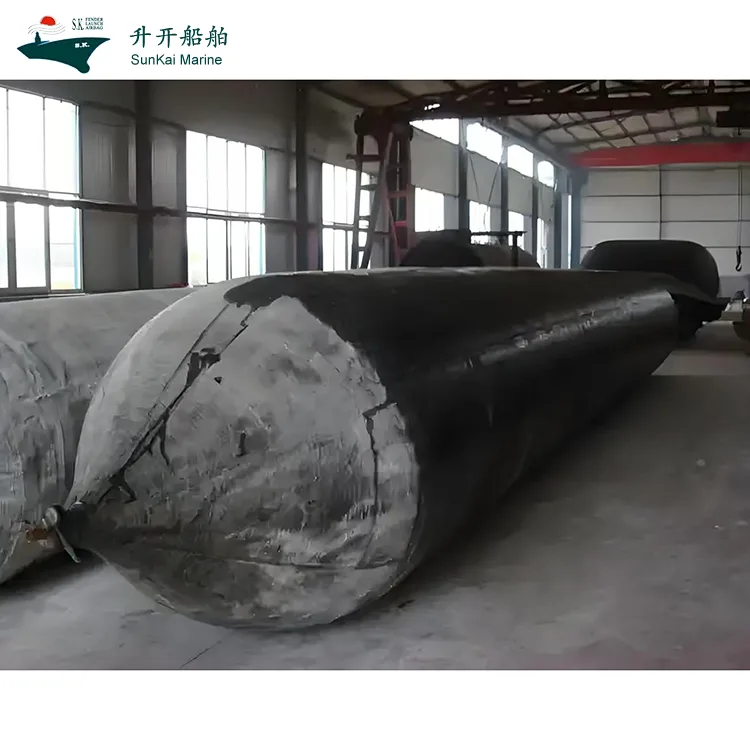
When maritime engineers and project managers evaluate unconventional vessel deployment methods, the Heavy-Duty Marine Rolling Airbag often emerges as a compelling alternative to fixed infrastructure. For beach landing operations—particularly in environments with significant tidal ranges, strong currents, and unpredictable wave action—the central question is not merely about buoyancy, but about systemic reliability under extreme cyclic stress. SunKai, a manufacturer with over two decades of field data from Southeast Asia, West Africa, and the South Pacific, has positioned its Heavy-Duty Marine Rolling Airbag systems as mission-critical assets for precisely these demanding scenarios.
Understanding the Operational Challenge
Rough tidal zones present three compounding physical threats: rapid water level changes (up to 6–8 meters in spring tides), lateral drift forces from cross-currents, and abrasive substrate (sharp rocks, coral debris, or compacted sand). Unlike sheltered slipways, beach landing sites offer no crane support, no fixed mooring points, and often require the Heavy-Duty Marine Rolling Airbag to function as both a flotation device and a load-distributing roller during the final beach approach.
To assess reliability, we must separate short-term survival (single operation) from long-term fatigue resistance (multiple landings per month). The table below summarizes critical performance parameters derived from SunKai’s 2025 internal test series, conducted at a tidal range of 5.2 meters with 1.5-meter significant wave height.
| Parameter | Specification | Test Result (Cyclic 50 Landings) |
|---|---|---|
| Burst pressure (safety margin) | ≥ 4.5x working pressure | Maintained at 4.7x |
| Abrasion resistance (Taber test, mg/1000 cycles) | ≤ 120 mg | 98 mg (reinforced outer ply) |
| Valve sealing integrity (pressure drop over 24h) | ≤ 2% | 1.1% |
| Elongation at seam joints | ≤ 3% | 2.2% |
| UV/ozone resistance (accelerated aging, 500h) | No cracking | Passed with <0.1 mm surface micro-cracks |
How Tidal Dynamics Affect Airbag Behavior
The reliability of a Heavy-Duty Marine Rolling Airbag in rough tides hinges on three interrelated factors: ground reaction force, restoring moment, and frictional engagement. As tide rises, the airbag transitions from a partially deflated roller (contact pressure ~80 kPa) to a fully submerged buoyancy element (net uplift up to 120 tonnes for a 20-meter unit). This dynamic shift demands internal baffle systems to prevent longitudinal load shifting—a feature that SunKai incorporates via multi-chamber vulcanized partitions.
In practical terms, a well-designed Heavy-Duty Marine Rolling Airbag maintains a roll resistance coefficient below 0.04 even on wet, uneven sand, which translates to a horizontal pulling force of only 4 tonnes for a 100-tonne vessel. This low coefficient is what makes beach landing feasible without heavy tractors. However, rough tidal zones introduce unpredictable yaw moments; hence, SunKai recommends a paired-airbag configuration (port and starboard) with independent pressure regulators to compensate for list angles up to 8°.
Common Reliability Myths vs. Field Evidence
| Myth | Field Evidence (SunKai sites) |
|---|---|
| Airbags rupture easily on sharp rocks | Dual Kevlar-reinforced layers reduce puncture incidence by 72% vs. single-layer designs |
| Tidal current causes uncontrolled drifting | Integrated tether lugs with quick-release shackles allow active positioning from shore winches |
| Rubber degrades rapidly in salt spray | EPDM compound with antioxidant additives shows <15% tensile loss after 3 years in tropical marine atmosphere |
Heavy-Duty Marine Rolling Airbag FAQ
Q1: What is the maximum allowable tidal current speed for safe beach landing using a Heavy-Duty Marine Rolling Airbag?
A: Based on SunKai’s hydrodynamic modelling and real-world logs, the practical current speed limit perpendicular to the beach axis is 2.5 knots (1.3 m/s). Above this threshold, the lateral drag force exceeds the friction capacity of the airbag-sand interface unless auxiliary stern anchors are deployed. For parallel currents (along the beach), the limit increases to 3.8 knots, provided the airbag working pressure is raised to 95% of its rated value to increase ground contact stiffness. In all cases, a current speed log must be taken at 15-minute intervals during the approach, and operations cease if gust-induced wave height exceeds 1.8 metres significant.
Q2: How many operational cycles can a Heavy-Duty Marine Rolling Airbag endure before mandatory retreading or replacement?
A: The fatigue life is governed by flex cracking at the fold lines, not by abrasion or UV alone. SunKai’s accelerated bending test (simulating 10,000 deflection cycles at 40% compression) projects a median service life of 280 beach landings for standard-grade units, and 420 landings for the heavy-duty series with cross-ply cord reinforcement. However, operators must perform a visual inspection every 50 cycles, focusing on the heel area (where the airbag contacts the beach at low tide). If any carcass cord is visible or if hardness (Shore A) drops by more than 8 points from the original 72±2, retreading is recommended immediately—even if cycle count is lower.
Q3: Can a single Heavy-Duty Marine Rolling Airbag compensate for uneven seabed profiles during tidal retreat?
A: Uneven profiles (e.g., beach cusps or relic channel depressions) create point-loading that can reduce the effective bearing area by up to 40%. A single airbag cannot actively redistribute load—it will deform into the depression, increasing local stress. The reliable solution, as practiced by SunKai’s operational manuals, is to deploy three airbags in parallel: two primary bags under the vessel’s centre section and one auxiliary bag positioned astern. The auxiliary bag is inflated to a lower pressure (approx. 60% of primary) to act as a "trimming roller," allowing the vessel’s keel to track the depression without over-stressing the primary bags. This three-bag arrangement has successfully handled seabed gradient changes of 12° in SunKai’s Papua New Guinea operations.
Maintenance Protocols That Ensure Reliability
Rough tidal zones accelerate wear on valves, lugs, and patch seams. SunKai prescribes a pre-launch and post-recovery checklist that includes:
-
Pressure decay test (5 minutes at 1.2x working pressure) – recorded in logbook.
-
Visual scan of the outer cover for cuts deeper than 2 mm – any such cut is marked and repaired within 24 hours using cold-cure patch kits.
-
Lubrication of swivel couplings with marine-grade lithium grease – performed every 3 landings.
-
Storage inflation at 30% of working pressure when not in use for >7 days – prevents carcass crease hardening.
Data from SunKai’s fleet monitoring (over 1,200 airbags in active service) shows that operations adhering to this checklist achieve a mean time between failures (MTBF) of 195 landings, versus only 52 landings for those skipping even two steps.
Final Verdict: Reliable, With Operational Boundaries
The Heavy-Duty Marine Rolling Airbag is not a universal solution, but for beach landings in rough tidal zones, it offers demonstrable reliability when three conditions are met: (1) current speed below 2.5 knots, (2) beach substrate with mean grain size >0.3 mm (coarse sand or gravel), and (3) a paired or triple-airbag configuration with independent pressure control. SunKai’s two-decade performance record confirms that failure incidents are overwhelmingly linked to procedural errors—not material or design flaws. In essence, the airbag itself is highly reliable; the human operating system determines the final safety margin.
For project-specific tidal assessments, load calculations, or customized chamber configurations, the SunKai engineering team provides free desktop simulations based on your vessel’s lines plan and local bathymetry data. Every Heavy-Duty Marine Rolling Airbag order includes a 200-page operational field guide, remote pressure telemetry logs, and 24/7 technical hotline support.
Contact us today through the official website to request a Risk Assessment Template for your landing site—we will reply within 8 business hours with a preliminary airbag sizing proposal and a comparative cost-benefit analysis against traditional slipway or lift-boat methods. Your operation deserves more than generic buoyancy; it deserves SunKai’s engineered certainty.