

SiC Coated Graphite Company Innovations in Thermal Management and Semiconductor Equipment
2026-11-02
If you’ve ever watched a wafer process drift as chamber temperatures climb, you already know why graphite alone no longer cuts it. SiC coated graphite is quickly becoming the quiet workhorse behind stable thermal management and longer-lived semiconductor equipment. At Semicorex, that shift is driving new approaches to coating density, thermal uniformity, and contamination control. Here’s a closer look at the innovations changing how fabs handle heat—and why they matter for your next process window.
The Real Reason Your Furnace Parts Fail Too Soon
Most people assume a blower motor dies early because it was built cheap. That's rarely the whole story. More often, the furnace was installed with undersized ductwork or a filthy filter left in for a year, forcing the motor to work against higher static pressure until it overheats. The part didn't fail on its own—it was pushed past its limit every single cycle.
Igniters and flame sensors get blamed too. What actually shortens their life is short cycling from an oversized furnace or a thermostat placed in a dead air pocket. The burner lights and shuts off before the heat exchanger ever gets comfortable, and every unnecessary ignition adds wear. After a few seasons, the igniter cracks, and suddenly you're told the part was 'defective.'
Even the heat exchanger can rust out early if condensate isn't draining properly or if the exhaust vent slopes the wrong way. Water sits where it shouldn't, acidic byproducts eat at the metal, and a fifteen-year part barely makes eight. The real reason your furnace parts fail too soon usually isn't bad luck—it's a chain of small installation and maintenance mistakes that never got corrected.
Coating Graphite with SiC Changes Everything About Heat Management
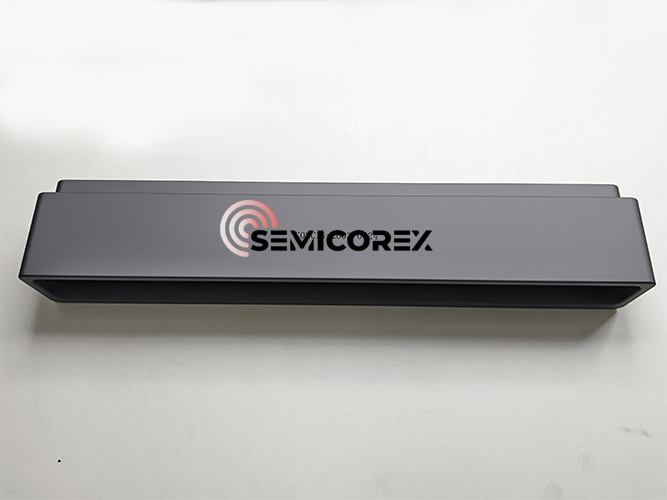
Most engineers assume graphite already handles heat well, until they watch it burn. The moment oxygen reaches hot graphite, the surface erodes into CO2 and the entire thermal path begins to crumble. Coating it with silicon carbide removes that failure point. SiC forms a dense, oxidation-resistant shell that remains stable past 1500°C, letting the graphite underneath keep transferring heat without turning into a disappearing act.
What surprises many is how the coating changes heat flow itself. Bare graphite is anisotropic: it conducts well along the planes but struggles through the thickness. A thin SiC layer evens out those differences and adds a radiative boost, driving more heat out through the surface instead of letting it pool underneath. That shift means heatsinks, crucibles, and plasma-facing components can run hotter and longer without the quiet creep of thermal failure.
A Closer Look at SiC-Coated Graphite for Next-Gen Etch Systems
SiC-coated graphite has moved from a niche material choice to a serious contender in next-generation etch systems, but the shift isn't just about swapping one coating for another. The real story lies in how the silicon carbide layer interacts with aggressive plasma chemistries—especially fluorine and chlorine-based etchants—at higher power densities. Unlike traditional uncoated or polymer-coated graphite, SiC forms a dense, chemically stable barrier that resists both erosion and particle generation, which directly extends chamber part lifetime. What makes this particularly interesting is the thermal behavior: graphite's high thermal conductivity remains intact under the coating, so you're not sacrificing heat dissipation for chemical protection. The interface between the SiC layer and the graphite substrate becomes the critical zone, where micro-cracks or delamination can quietly undermine performance if deposition parameters aren't tightly controlled.
Another overlooked aspect is how SiC-coated graphite changes the contamination profile inside the chamber. With bare graphite, you often see carbon dust or reactive carbon species redepositing on wafers, causing yield-killing defects. The SiC coating drastically reduces this outgassing and particle shedding, but it also introduces a new variable: trace silicon or carbon stoichiometry shifts depending on the coating process. Some etchers are now tuning their process recipes to account for the subtle differences in surface recombination rates on SiC versus other chamber materials. This isn't just theoretical—engineers running high-aspect-ratio silicon etch processes have reported measurable improvements in CD uniformity after switching to SiC-coated graphite electrodes and focus rings, though the gains vary with chamber design and gas mix.
Looking forward, the next generation of etch systems will demand even more from this material pairing. As feature sizes shrink below 3nm and etch selectivity margins tighten, the purity and microstructural integrity of the SiC coating become non-negotiable. We're already seeing work on graded SiC layers that transition from carbon-rich at the graphite interface to silicon-rich at the plasma-facing surface, aiming to balance adhesion strength with chemical inertness. There's also a push toward reduced-thickness coatings that maintain protection while minimizing any thermal resistance penalty. The challenge isn't finding a coating that works—it's making it repeatable across thousands of chamber cycles without drift. That's where the real differentiation will happen, and why SiC-coated graphite is no longer just an upgrade option but a baseline expectation for advanced etch tools.
How One Material Upgrade Cuts Contamination in Wafer Processing
Swapping a single component in the wafer handling path can dramatically reduce particle generation, but the real story is how the new material behaves under plasma exposure. Traditional fluoropolymers shed micro-scale debris after repeated thermal cycling, yet a modified polyimide blend retains its surface integrity even at elevated chuck temperatures. This isn't just a marginal improvement—it shifts the contamination baseline low enough that downstream inspection tools stop flagging false positives.
What gets overlooked is the triboelectric interaction between the upgraded material and the wafer backside. The lower surface resistivity prevents charge buildup that would otherwise attract airborne molecular contaminants. Operators often assume cleaner wafers come from better filtration alone, but the material change interrupts the contamination mechanism at the source. Fewer particles mean less frequent chamber wet cleans, which in turn reduces tool downtime and extends the mean time between preventive maintenance cycles.
The material's outgassing profile also matters more than its bulk purity. Low-molecular-weight siloxanes and plasticizers are notorious for condensing on cold chamber walls, then redepositing on subsequent wafers. By selecting a grade with near-zero volatile condensable content, the upgrade eliminates a hidden source of organic haze that standard particle counters never detect. Wafer-level defect maps become cleaner not because the process changed, but because the environment stopped fighting against it.
What Engineers Need to Know About SiC-Coated Graphite
Thermal expansion mismatch is the first thing to check. The graphite substrate expands at roughly 4-5 × 10⁻⁶ /K while SiC sits closer to 4.0 × 10⁻⁶ /K. That small difference doesn't sound dramatic, but during rapid heating or cooling the interface stress builds up quickly. A graded transition layer or a carefully controlled deposition temperature can reduce the risk of cracking, but engineers should ask suppliers for actual CTE curves rather than a single number.
Don't assume the coating is a perfect barrier. Even high-quality SiC layers contain pinholes or microcracks, especially if the graphite was machined with sharp edges or the surface finish wasn't optimized. Under oxidizing atmospheres above 1200°C, oxygen can reach the substrate through these defects and cause localized erosion. If your application involves repeated thermal cycles, request cross-sectional SEM images or porosity data to verify the coating integrity before committing to a design.
Mechanical handling is often overlooked. SiC-coated graphite components are hard but not indestructible; the coating can chip at edges or under point loads. In semiconductor wafer carriers or MOCVD susceptors, installation torque and thermal expansion of adjacent parts need to be accounted for. A small chip may not affect electrical performance immediately, but it creates a weak spot for future coating delamination. Engineers should include protective edge radii and specify allowable contact stress in their drawings.
Thermal Management Tricks from a SiC-Coated Graphite Specialist
Most people overlook that SiC coatings on graphite do more than resist oxidation—they change the surface emissivity in ways you can tune. A specialist trick is to specify a slightly rougher SiC finish on the backside of a susceptor or crucible. That roughness pushes effective emissivity up toward 0.85–0.9, which lets you pull heat out of localized hot zones without altering the bulk graphite grade.
Another underused move is edge termination. Bare graphite edges bleed heat faster than coated faces, so we often mask the edges and apply a thinner SiC layer there on purpose. It sounds counterintuitive, but the thin edge coat creates a controlled thermal break that keeps the center-to-edge delta under 15°C in high-power RF heating. If you coat edges thick and uniform, you can actually make the thermal gradient worse.
Finally, don't treat SiC thickness as a fixed spec. For pulsed heating, a 40–60 µm coating on the top face and a 10–20 µm coating on the sidewalls shifts the thermal time constant enough to avoid cracking during rapid ramp-up. Pair that with a graphite grade that has high in-plane conductivity, and you get a thermal management setup that survives cycles most off-the-shelf parts won't.
FAQ
The coating seals the graphite surface, blocking particle release and oxidation at temperatures where bare graphite would degrade quickly. That helps keep wafer environments cleaner during processes like epitaxy or ion implantation.
We tune the coefficient of thermal expansion between the graphite substrate and the SiC layer. By adjusting deposition parameters and using intermediate layers, the coating stays intact through repeated heating and cooling cycles, which is essential for batch furnace parts.
MOCVD susceptors, etch chamber liners, and ion implantation components are the main ones. These parts face aggressive chemistry and high heat, so the coating has to act as both a chemical barrier and a thermal conductor.
Yes. We machine the graphite first to the required shape, then apply the SiC coating via CVD. That allows complex recesses, holes, and curves to be coated evenly without the risk of post-coating machining that would crack the layer.
We typically reach total impurity levels below 5 ppm for metals. In semiconductor processing, even trace metals can alter doping or create defects, so a high-purity coating directly reduces wafer yield loss.
The graphite base spreads heat efficiently, while the SiC layer provides a stable, emissive surface. This combination minimizes temperature gradients across the wafer pocket, which is critical for uniform film growth in MOCVD.
We control the coating's surface roughness and avoid over-coating edges and corners where stress concentrates. Ultrasonic cleaning and vacuum baking before shipment further remove loose particles, so the parts arrive cleanroom-ready.
The coating protects the graphite from erosion by halogen gases and plasma, so parts don't need replacement as often. Longer intervals mean less tool downtime and fewer handling risks for production wafers.
Conclusion
Furnace parts usually fail early because bare graphite oxidizes at high temperature and sheds micro-particles every time the chamber cycles. That failure mode changes once the graphite is coated with silicon carbide: the dense SiC barrier blocks oxygen ingress, withstands rapid thermal cycling, and keeps expansion nearly uniform across the part. In next-generation etch systems, this translates into longer-lived heaters and susceptors, more stable wafer temperatures, and almost no thermal drift during plasma exposure. A specialist's thermal management tricks lean on this coating to flatten hot zones and push heat exactly where the process needs it, instead of letting it soak into chamber hardware. Coating thickness, adhesion, and edge coverage matter more than most datasheets admit, because a thin or porous layer cracks early under the same thermal shock that bare graphite cannot survive.
The same upgrade also cuts contamination in wafer processing. SiC surfaces resist aggressive fluorine and chlorine chemistries and do not flake the way raw graphite does, so particle counts drop sharply. Engineers weighing materials should note that SiC-coated graphite keeps graphite's machinability and high thermal conductivity while adding a ceramic shield that survives repeated clean cycles. In practice, that means fewer mid-campaign part swaps, cleaner process chambers, and a more predictable thermal budget. Process engineers often see the difference in backside particle scans within the first lot, and maintenance teams notice longer intervals between furnace rebuilds. Both benefits directly improve yield and tool uptime in advanced semiconductor manufacturing.
Contact Us
Contact Person: Svenja Wei
Email: [email protected]
Tel/WhatsApp: +8613567891907
Website: https://www.semicorex.com